Facebook UU Lab Directory as of 11/11/11

UU Growth Lab on FacebookThe following is a directory of topic focused UU labs on Facebook.  After I launched the UU Growth Lab in February 2011, lab members immediately started launching “spin-off” labs in an organic fashion.   For those not familiar with the UU Growth Lab, I like to think of it as a virtual lounge where UU leaders can discuss issues related to the healthy, growth and future of Unitarian Universalism 24/7.  The other labs are similar, just with focused topics.

Thanks to all who have worked to create, nurture and growth the various lab communities on Facebook!

Here are the labs listed in launch order.

Growth, Front Doors and Foyers in the Digital Age

In this post, a call to action for congregations wanting to grow but not fully realizing that their front door and first greeting space has moved online.

Plus information on related UU Labs on Facebook. And yes, I know this is a hard transition.  But it is necessary.  If you’re stuck, ask for help and get movin’ before you lose another potential member and they suffer as a result.  😉

It is November 2011, almost 2012!  Do you know where the front door to your congregation is?   Many don’t…

For years your front door was the street-side door to your physical sanctuary with small groups and other connecting experiences serving as side doors.  Today the  front door is your congregation’s website.  Nearly 100% of people visiting a church visit the website first, conduct research, engage with your social media, and “pre-qualify” themselves for membership before they attend. People arrive having had multiple virtual visits to your congregation.

Think of it this way…

You have a virtual front door, your website, connecting to an online foyer, your social media and our larger Unitarian Universalist online space.  People enter your front door and from there connect to information, social media and other related Unitarian Universalist resources and online communities.  After a time in this environment,  if people like what they see and if you engage with them, they will move to through to your physical entry way. Again, nearly everyone travels through your online front door first, that makes it your primary front door.

We need to care for our virtual front door and foyer with as much care as the rest of our congregations.  How does it look? How does it feel?  Do you have greeters in the foyer?  Remember, nearly 100% of visitors start there.

Websites and PR are not PR for your ministry, they are the front line of your ministry and education with newcomers.  Much of the process of educating people and their preparing to join is now happening in these virtual spaces.  All that work you’ve been doing with greeting and hospitality?  It has to start online.  Yes, thanks to technology, the first half of your welcoming and membership process has moved online.

Where does that leave us?  Your website is your most important publication, communication tool and, with associated social media, a critical part of your ministry if you want to grow.  Don’t undermine your ministry with an outdated website and reluctance to use the communication and relational  tools of our time.

Finding Help

I’m now guest preaching on “Friendship in the Digital Age”, a service designed to help people see this shift, and offer related trainings, coaching and consultations.  Contact me to discuss where you are and how I may be of assistance.

I also highly recommend that the people responsible for various aspects of your online ministry (website, social media, minister’s blog, etc…) connect with related UU labs on Facebook. See below.

UU Website and Social Media Labs

For those of you working with congregational websites and/or social media, two related labs on Facebook have spun-off from the UU Growth Lab, the brand new UU Website Lab and the UU Social Media Lab.  Both offer community, resources and inspiration  —  I highly recommend them.  More information below.

UU Website Lab
http://www.facebook.com/groups/uuwebsitelab/
UU community lab for web administrators, designers and developers, communications enthusiasts and anyone else working specifically on congregation or UU community sites (note that there’s a separate lab for those who doing social media stuff online). Join us for site reviews, tips and tools, and (the ever compelling) much, much, more!  (As of 11/8/11)

UU Social Media Lab
http://www.facebook.com/groups/uusocialmedialab/
UU Social Media Lab is a place to post social/new media projects, share ideas, and collaborate on ways Unitarian Universalists can develop and use social/new media in justice, service, education, and other practices of our institutional and individual religious lives. (As of 11/8/11)

Surveys and thoughts on Freerange UUs

A new survey for freerange UUs has just been created by the UUA’s Office of Growth Strategies.  I hope you’ll share this with your friends, colleagues and congregation at large.

Here’s the survey announcement:

Seeking Free-Range Unitarian Universalists…
by Tandi Rogers
If you’re a “Free-Range Unitarian Universalist,” please take this survey: http://www.surveymonkey.com/s/FreeRangeUUs. The UUA Office of Growth Strategies is seeking to better understand Unitarian Universalism outside our congregations. Help me transform the way we live into our faith. If you’re active in a congregation, but know people who aren’t, but identify as Unitarian Universalist, please pass this on to them. Thank you!!  In faith, Tandi

From a growth perspective,  I think figuring out how to cultivate (not control) a larger Unitarian Universalist movement is critical.   Often I hear people using the words movement and religion interchangeably.  They are very different. A few thoughts on that in older post Is Unitarian Universalism a Religion or a Movement?

For more on the difference between a movement and a campaign, read the book Brains on Fire: Igniting Powerful, Sustainable, Word of Mouth Movements.  For some inspiration on starting a movement, watch the Ted Talk video Seth Godin on the tribes we lead.

FREERANGE-UU-SEALI’m very happy to see the UUA taking what I call “Freerange UUs” and, if they had a sports team, “the UU Freerangers” seriously.   Since I started tweeting approximately three years ago (via account @uuplanet) I’ve come into contact with freerange UUs who feel that they aren’t allowed to be Unitarian Universalists because they aren’t connected to a congregation.  Some have expressed that they don’t feel like they have permission to be UU in any way other than the building bound form.  My response has been “With all the authority NOT invested in me, I hereby give you permission to be a Unitarian Universalist!”  

Some of my colleagues have challenged me on it being valid to be UU outside of a congregation.  I gotta tell you, if Unitarian Universalism is small enough to be contained in our existing congregations, it is too small of a thing for me.   The Unitarian Universalist Association of Congregations — this organization is rightly bound to congregations.  But I don’t think our larger faith should be.

Some of you may be wonder, why aren’t these people connected to existing congregations?  There are so many reasons.  Here are some highlights.

  • There is no local congregation
  • The local congregation is Sunday morning centric and they work then
  • They identify with our faith, but not our present demographics
  • They are in transition
  • The spouse they are divorced from is occupying the local congregation
  • They were asked to pledge their third time at the congregation and feel the church is all about money
  • The congregational leadership is constantly begging for volunteers giving a sense that it is a sinking ship
  • The congregation is filled with unhealthy politics
  • The congregation is old and they are young
  • They have accessibility issues
  • They “married out”
  • The local congregation stinks — it happens.
  • And on and on…

I’m looking forward to seeing what comes from the UUA’s Free-range UU survey.  Even more, I’m hoping that the UU Freerangers will start organizing themselves, that a movement will ignite.  There are far more of them in the United States than there are members of the Unitarian Universalist Association.

Again, I hope you’ll share the survey.

In faith,
Peter

Ministry and Media for All Ages workshop – Nov. 19. 2011

Friends, if your congregation is within reasonable travel to Southern New England please share this event reminder with your congregation.   My workshop will be focused on MEDIA and MINISTRY  for all ages.  I’m designing it with a wide range of participants in mind — religious educators, clergy, volunteer teachers, youth advisors, youth, young adults. 

You may download a PDF flier to share here  as well as use the sharing buttons at the end of this post to share via social media.

See details below for additional workshops on RE committees and working with special needs.  Interested in my workshop but can’t make it on November 19th?  I’m scheduled to lead a week-long workshop with a similar theme at the Star Island LRE week this coming Summer.  ~ Peter


Ballou Channing District
Fall Religious Education Conference
“We’ll Build A Land”
https://i0.wp.com/evbdn.eventbrite.com/s3-s3/eventlogos/3414525/2157256412-1.jpg

A conference for religious professionals and religious education volunteers.
Saturday, November 19, 2011
8:30am to 12pm

DOWNLOAD FLIER:
November 19th 2011 Fall RE Conference Flier (PDF)


REGISTER ONLINE
:
bcduua2011reconference.eventbrite.com

Location

Unitarian Church of Barnstable
3330 Main Street
Barnstable, MA 02630-0285

Schedule

  • Registration 8:30am
  • Worship: We’ll Build a Land  9:00 to 9:45
  • Workshops (descriptions below)10 to 11:30
  • Close by noon.

Food
No meals will be served during this morning program, but hardy snacks, coffee and the like will be available throughout.

Workshops

1) Effective Religious Education Committees
Panel hosted by Diane Elliott
The committee is an important aspect of church life where there is underlying philosophy and belief about the committee and the people who serve on it. Having an effective committee is vital for the growth of the church and the strength of the RE Program.  We hope you will join us to learn more about how committees work and what you can do to help them to function better.  We will learn about the ways to structure committees, what tasks and goals need to be created and ways that you can help to make your committees stronger.  We will hear stories of functioning committees and stories of how committees can were not so functional.

Diane Elliott: BCD Coach for Religious Educators. Diane has had 25 years worth of experience working with RE committees.

2) A Child With Special Needs ….in My RE Class…What Do I Do Now?
With
Michelle Cote
Michelle CoteThis workshop will be a hands on, practical overview of how to deal with children and youth who are in your programs who may ( or may not be!) identified as having special needs. Topics that will be covered are behavior redirection, strategies to deal with the active child, helping children with learning disabilities and setting up a potential buddy system. Bring your scenarios, issues and concerns.  Be prepared for some active role-playing!  The goal of this workshop is to give you hands on techniques that you can teach to your volunteers or use yourself as you work with children and youth.

Michelle Cote is in her fourth year as Director of Religious Education as First Parish Church of Stow & Acton.  Prior to taking her position there she taught in private and public school settings as a special educator and a Literary Specialist for over 25 years.  She has worked with children and youth of all abilities and feels that you can always find the good side to every child!

3) Multi-Media and Ministry for All Ages
With Peter Bowden
Peter BowdenWe live in a society that is increasingly media oriented. This presents a huge opportunity for congregations!  This workshop will look at ways media — primarily video — can be integrated into our ministry and religious education.  Workshop will include a brief presentation, video crash-course (video made simple), and time to share other tools participants are using in their congregations.  Participants are encouraged to bring video cameras and other tech for show-and-tell, as well as to share success stories with Peter in advance. Contact him via email, Facebook or phone at 617-744-9784.

Peter Bowden, BCD Growth Consultant, is also a television producer and media consultant.  He works on multiple nationally syndicated childrens television programs and speaks regularly on media, communication and culture change.

Healthy Congregations: A systems theory approach

Last week Amy and I attended a Healthy Congregations™ Facilitator Training in St. Paul, MN at the Luther Seminary.  Led by pastors Roger Schwarze and Bill Strom.   Though I had read Peter Steinke’s book, Healthy Congregations (Alban),  it was great exploring systems theory and congregational life with the small interfaith group of assembled participants.  If you are a leader in a Unitarian Universalist congregation, I highly recommend finding opportunities to collaborate with interfaith colleagues.

We are offering our first related trainings in the Ballou Channing District later this month.  I’ll be co-facilitating these seminars with the Rev. Bill Zelazny, BCD District Executive.

As a trained Healthy Congregations facilitator, I am now available to lead HC workshops for individual congregations.  I’m looking forward to weaving these trainings into my work with our congregations.  If you haven’t heard of Healthy Congregations, here is some basic information including a short video overview.

What is Healthy Congregations?     

The following is an excerpt from the HC website:

Healthy Congregations is an ecumenical and interfaith organization that takes seriously the times that we live in and the challenges of thinking more clearly about families, congregations, and leadership.

Healthy Congregations, Inc. offers resources and training that are based on a view of life that looks at communities as living systems that incorporate thinking, feeling, responsibility, and purpose. 

Making use of the contributions of leaders in the field of Bowen family systems theory and congregational life, Healthy Congregations, Inc. has created educational resources and leadership development material designed with the purpose of encouraging healthier, clearer and deeper individual and community life.

What are the benefits?

These workshops designed to help  participants:

  •  Gain a renewed sense of purpose and mission
  •  Cultivate strong leadership capacities push their congregations to new levels 
  •  Learn how to develop healthy patterns of living together in community
  •  Learn to focus on strength, resources, and options for the future
  •  Boost confidence in responding to challenges and opportunities
  •  Reflect theologically about relationships
  •  Move the congregation toward healthy functioning

“Healthy Congregations: A systems theory approach” cross-posted on LeadingCongregations.com

The Skype’s the Limit!

The following guest post by the Rev. Aaron Payson and the Rev. Thomas Schade features a collaborative Association Sunday experiment using Skype.  Love it!   ~ Peter

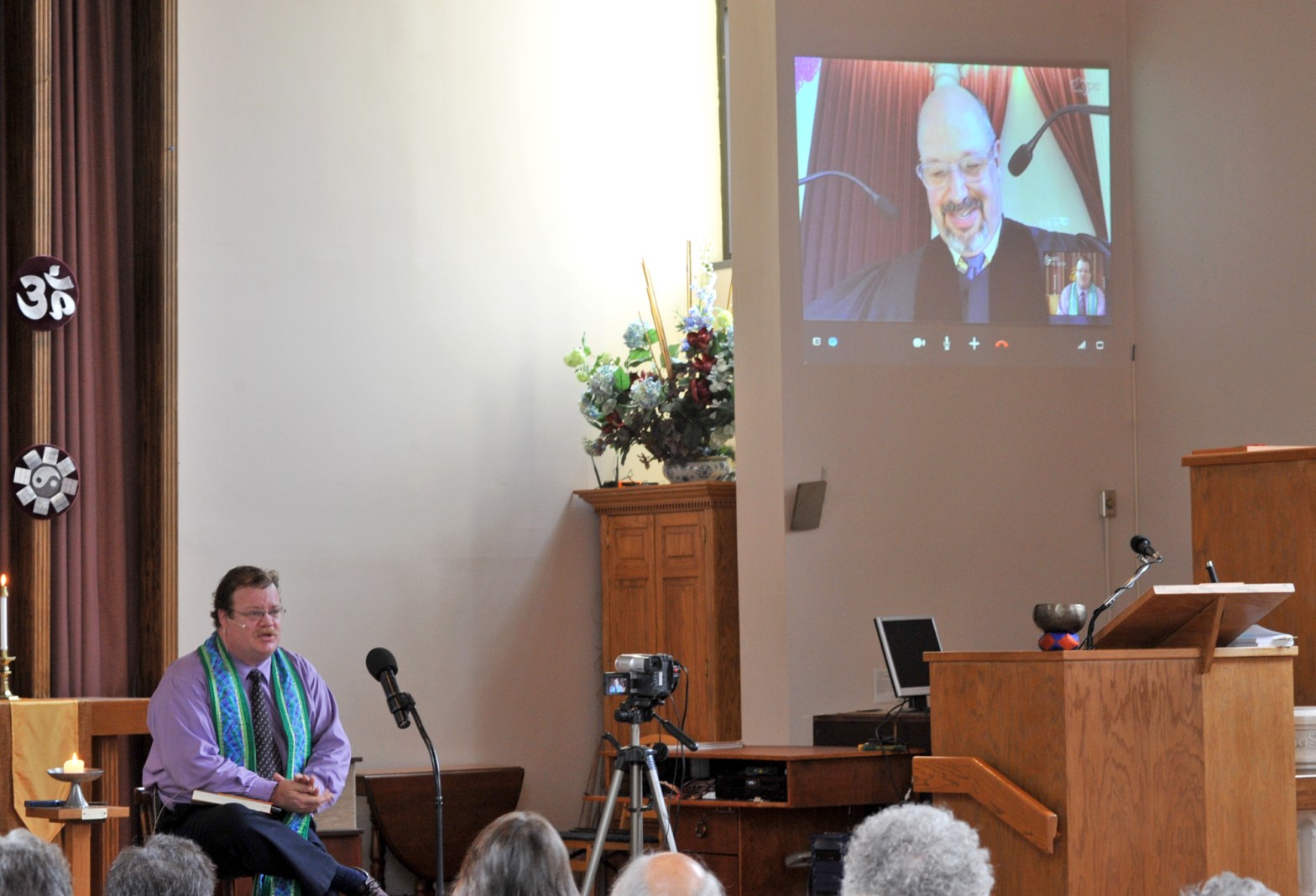
SHOOT DATE: OCT. 2, 2011 - Association Sunday - Unitarian Universalist Church of Worcester (Mass.) At left, Rev. Aaron Payson. At right, on screen, Rev. Tom Schade, First Unitarian, Worcester (Mass.)


“What could 600+ Unitarian Universalists do in Worcester?” This was the central question that inspired an experiment in the use of technology and congregational cooperation during the 2011 Association Sunday services held October 2 in two Worcester, MA congregations.

Wedding the themes of the Jewish High Holidays and Association Sunday, Revs. Payson and Schade conceived of a plan to be present together in both sanctuaries simultaneously on Association Sunday to dialogue about strengthening the ties that bind the congregations together within the larger UU movement.  The Jewish High Holidays presented an opportunity to reflect on repairing the ties that bind us together.  Association Sunday was an apt opportunity to outline a vision of cooperation between congregations.

It was clear to both Tom and Aaron that the two Worcester congregations had largely operated in parallel over the 50 year history since merger.  Unique in their histories and styles of worship, old assumptions about each congregations personality and theological make-up have hitherto inhibited an attempt to conceive of a Unitarian Universalist presence in the wider community that transcended the boundaries of each UU community.

But the growing awareness that the social networks crafted by members in each community often linked them together in ways that made distinctions between the congregations negligible as far as friendships were concerned. This, combined with the efforts on the part of members of both communities to commune together on the 3rd weekend of September in a combined weekend of social activities at Ferry Beach Camp and Conference Center in Saco, Maine, and the history of cooperation between the youth of both congregations both in terms of youth group programming and a combined youth c choir, suggested that this was a relationship worth revisiting and reimagining.

Technology teams in both congregations set up computers and video recorders in their sanctuaries.  A Friday test run of the technology using skype as the shared medium for projecting each into the other’s sanctuary went well.

On Sunday the video feed was near perfect, but Skype provided a few tense moments of audio-fluctuation as well as a disconnection of the video feed due to computer presets.  This, however, did not dampen the energy and enthusiasm garnered in both communities for the novelty of the experience and the opportunity it provided for each congregation to be inspired to consider ways of doing more together.

One parishioner at the UU Church of Worcester immediately commented that she’d like to start a poetry cooperative and had a vision of a Sunday where poetry authored by members and friends of both congregations could be incorporated  into worship in both communities on that day.

From our perspective, the exercise was a good first step toward a larger conversation we are planning for winter 2012 when representatives from both communities will meet to discuss the possibilities of a larger UU mission in Worcester.

Such an effort recognizes the unique character and gifts that each congregation embodies and the reality that such we also have much in common about a community made more peaceful, loving, and just if we could unite or passions toward a common, transformative, purpose in the city and region that sustains us both.

———————-
Rev. Aaron Payson is the minister of The Unitarian Universalist Church of Worcester, MA.

Rev. Thomas Schade is minister of the First Unitarian, Second Parish, Worcester, MA.sdf
Rev. Aaron Payson Rev. Thomas Schade