5 Ways Social Media is Changing How People Join Congregations

This article is cross-posted on my blog for congregational leaders and is excerpted from my online video course Church Social Media and Membership Growth.

With approximately seven-in-ten Americans now using at least one social media site (Pew Internet), faith leaders can’t afford to ignore the impacts of digital culture.

Here are five ways social media is changing the process of connecting with and joining congregations.

 1. Visitors do extensive research online

People research congregations and their faith traditions extensively online.

In our digitally oriented culture, if you are going to buy or choose something, or make an important life decision,  you do your homework.

You do a Google or other search. You watch videos, read reviews, and do everything you can to educate yourself so you can make a well-informed decision. People interested in a congregation default to a similar process.

 2. Before visiting, people participate remotely

After their initial research, many people choose to follow the congregation for a time on social media.

Observing and participating remotely through Facebook, Twitter, audio podcasts, and other channels helps to determine if the congregation is a match for them.

Whether it takes weeks, months, or a year, at some point (hopefully) they will learn and experience enough to say, “YES! This is the congregation for me. I belong here.”

3. A higher degree of certainty is required to initiate an onsite visit

This calls us to use social media for more than an outreach.  We need to use it to meet people where they are — online — and to proactively help them with their process.

If we want people to visit,  they need access to information, have questions answered, and receive some affirmation that they are going to fit in.

Once someone is confident that the congregation is likely to be a great match,  then they’ll visit.

4.  High-stakes visits verify the match

After weeks, months, or a year of interacting with a congregation online, it is a big deal to visit onsite and see if people like them.  Will they?  Won’t they?

This isn’t a regular “let me check this place out” visit.  This is the moment of transition from ONLINE participation to ONSITE participation with very high hopes and expectations.

This sort of visitor needs affirmation and to connect with others almost immediately.

5. Visitors need immediate affirmation and connection

How long do you think a visitor will hang around waiting to be affirmed and connect with the community before they give up and leave?

In my trainings, I tell congregational leaders to play it safe and assume they need to offer this affirmation during the first visit.   Because if you don’t, it may very well be the only visit.

Now everyone’s different and you may have more time, but not much more.  It is essential to affirm visitors quickly and offer clear next steps for connecting with your community.

There are many ways we can use social media and online communications to offer this affirmation and start the connecting process before the visit.  We can start the process online.

These changes create a wide range of challenges and opportunities for congregations.  In my next post, I’ll share some of the ways congregations can start to respond.

Receive this and future posts, subscribe to Get Email Updates

Related Training

Interested in this topic? My new course Church Social Media and Membership Growth is a 3-hour on-demand training sharing the top strategies from my day-long seminars.

Readers of this site can enroll for $10 now through March 15th. That includes life-time access and a 30-day money back guarantee.  Just use the links on this post to get the full discount.        

5 Ways Social Media is Changing How People Join Congregations

With approximately seven-in-ten Americans now using at least one social media site (Pew Internet), faith leaders can’t afford to ignore the impacts of digital culture.

Here are five ways social media is changing the process of connecting with and joining congregations.

 1. Visitors do extensive research online

People research congregations and their faith traditions extensively online.

In our digitally oriented culture, if you are going to buy or choose something, or make an important life decision,  you do your homework.

You do a Google or other search. You watch videos, read reviews, and do everything you can to educate yourself so you can make a well-informed decision. People interested in a congregation default to a similar process.

 2. Before visiting, people participate remotely

After their initial research, many people choose to follow the congregation for a time on social media.

Observing and participating remotely through Facebook, Twitter, audio podcasts, and other channels helps to determine if the congregation is a match for them.

Whether it takes weeks, months, or a year, at some point (hopefully) they will learn and experience enough to say, “YES! This is the congregation for me. I belong here.”

3. A higher degree of certainty is required to initiate an onsite visit

This calls us to use social media for more than an outreach.  We need to use it to meet people where they are — online — and to proactively help them with their process.

If we want people to visit,  they need access to information, have questions answered, and receive some affirmation that they are going to fit in.

Once someone is confident that the congregation is likely to be a great match,  then they’ll visit.

4.  High-stakes visits verify the match

After weeks, months, or a year of interacting with a congregation online, it is a big deal to visit onsite and see if people like them.  Will they?  Won’t they?

This isn’t a regular “let me check this place out” visit.  This is the moment of transition from ONLINE participation to ONSITE participation with very high hopes and expectations.

This sort of visitor needs affirmation and to connect with others almost immediately.

5. Visitors need immediate affirmation and connection

How long do you think a visitor will hang around waiting to be affirmed and connect with the community before they give up and leave?

In my trainings, I tell congregational leaders to assume they need to offer this affirmation during the first visit.   Because if you don’t, it may very well be the only visit.

Now everyone’s different and you may have more time, but not much more.  It is essential to affirm visitors quickly and offer clear next steps for connecting with your community.

There are many ways we can use social media and online communications to offer this affirmation and start the connecting process before the visit.  We can start the process online.

These changes create a wide range of challenges and opportunities for congregations.  In my next post, I’ll share some of the ways congregations can start to respond.

Get new posts delivered to you.

Get Email Updates


Welcome to the Leading Congregations blog and video series!

https://youtu.be/gWfYpO5RW3s

Welcome to the new Leading Congregations website, video series, and blog with me, Peter Bowden.

To help leaders keep pace with our rapidly changing world, I’m going digital! That’s right, I’m bringing my education work with congregations online via this new blog, video series, and on-demand courses.

GET EMAIL UPDATES

What To Expect

I’ll be talking congregational growth strategies,  changing culture and technology,  trends in religion and spirituality, and more.   Today much of my work and research is focused on how faith communities across religious traditions are integrating digital culture and congregational life.  That’s the hot topic people want me to speak on most, but I’ll be sharing a wide range of content.

I work with leaders across faith traditions and a growing range of congregations, ministries, and entrepreneurial projects.  The content I share will reflect this and I hope will be of value to my growing multi-faith audience of religious leaders.

Who Am I

I’m Peter Bowden.  For years I’ve been training clergy, staff, and volunteers on a wide range of issues related to congregational life and ministry.  Since 2002 I’ve worked as an independent parish consultant and educator.  Read more.

What about you?  I would love to know more about you,  your interest in congregations, and your questions.

You may tell me more about yourself in a comment below. You can also connect with Leading Congregations on Facebook or Twitter and tag @LeadingCong in a post or tweet.

If you want to submit a question, use the Question Box.

Get New Content

The best way to make sure you don’t miss anything is to subscribe via email. I’ll make titles clear so you can immediately determine if you want to read, share or skip. You may also follow Leading Congregations on Facebook and Twitter.

GET EMAIL UPDATES

The Boston Mass Graves Pipeline Protest

Boston, MA — In an effort to bring attention to the growing number of deaths caused by climate driven extreme heat and the dangers of continued fossil fuel extraction, Boston area activists staged the “Mass Graves Pipeline Protests” on June 29th.  To connect the dots between mass graves in Pakistan and the trenches being dug by Spectra Energy in Boston’s West Roxbury neighborhood, activists including my colleague Tim DeChristopher (I do media work with Tim) and Al Gore’s daughter, Karenna Gore, stormed and occupied the pipeline trenches.

A total of 23 people were arrested with six seeking to go to trial, including Tim DeChristopher and Karenna Gore.  They are calling themselves the Mass Grave 6.

The morning of the action I asked Tim how he was thinking of it.  Is this direct action?  A funeral?  A die-in?  Tim suggested this might be something new as we enter a new age of anticipatory mass graves.

After a series of eulogies for those who have died as a direct result of climate change,  Tim DeChristopher spoke on our entering the “Age of Anticipatory Mass Graves.”

You can see more of my footage and footage by Kori Feener (she filmed activists taking the trench) in the following Democracy Now! segments.

My photos from the action are available for media use at https://flic.kr/s/aHskDcoQPY with photo credit: Peter Bowden

This slideshow requires JavaScript.

Tips for attending UUA General Assembly 2016 Edition

PrintThe following list of tips for attending the General Assembly conference of the Unitarian Universalist Association was first made collaboratively by the UU Growth Lab in 2011. I have been updating based on your comments.  Have a tip? Add it as a comment on this post. UUA’s 2016 General Assembly takes place June 22-26 in Columbus, OH.

Follow the UU World’s Coverage:

Before you go:

  • Plan your GA life assuming you will not be able to access wi-fi in the convention center.  Internet access is always and issue. Bring critical information and contact numbers with you. If access is good, enjoy! Otherwise, be prepared.
  • Order a Standing on the Side of Love yellow shirt if you want to join the crowds who will wear these shirts during the Public Witness event.
  • Convention centers, especially the main halls, are usually freezing! Bring a layer you can easily take on and off so you’re okay going from outside to hallways to the general session/plenary ice box…
  • Hydrate! Bring a water bottle. If you’re flying, bring an empty one to fill at a water fountain after you go through security.  You can usually buy a reusable bottle in the Exhibit Hall.
  • If you’re representing your congregation and they have a budget, you might be able to get some good discounts on curricula, books, and marketing materials (banners, postcards, etc.) but remember you’ll have to have a way to get them back.
  • If you are a delegate, READ related business materials before you come.  You are deciding our future. Everything delegates need to review is  available here.
  • GA is amazing for network and learning.  Bring business or personal cards so that you can give your information to others.
  • Be sure that someone from your congregation is bringing the banner.
  • Download & review the Program Guide and/or Mobile App ahead of time.
  • The UUA GA Mobile App is amazing!  If you have a smartphone, make installing it a priority. It will significantly improve your GA experience.
  • You downloaded the Mobile App, now make sure you play with it before you arrive. There are a lot of features. You can choose to follow posts by other attendees, share your own posts tagging which event you’re at, and much more.  The week leading up to GA, try opening the app each day. People will already be posting.  Give it a try!
  • Plan out what workshops you want to go to, but don’t be wedded to the idea.  Pick a few you certainly want to go to, but be open because you’ll change your mind at least once while there.
  • Pick a 2nd workshop for each time slot. You may find that when you arrive at your first choice it’s not what you expected and it will be good to know exactly where to go to find your 2nd choice. (Also, at some GAs, the rooms were too small and you could find yourself unable to attend your 1st choice because it was full.)
  • Pack comfy shoes.
  • Bring a bag you can carry comfortably with you at all times, like a shoulder bag or light backpack.
  • If you’re asked to carry your congregations banner during the banner parade, figure out how the poles/carrying PVC pipes go together before hand.  Here are banner specs from the UUA (pdf).
  • “Last year I had a binder where on the back cover I had a map of the area in the plastic cover thing, the front with my delegate card and other really important info, and inside my travel info, the program book, the business resolutions, etc.  It really helped me stay organized throughout.  Put in paper to take notes on, bring pens, etc.  I had that with me in my laptop bag and it was great.”
  • Talk to people in your congregation to find out about resources you can scout out and bring home and questions they might have, especially if your congregation has a very limited budget and will be under-represented by delegates. It is even nicer when you reach out to area congregations if your cluster is composed of smaller, less financially able congregations, and see how you can help.
  • If you can’t walk more than a mile easily, you will want to rent a scooter through GA Accessibility Services. If you often use hearing assistive devices in crowded settings, you will want to use GA Accessibility Services. Better to reserve equipment you turn out not to need than arrive & be blocked from participating because no extra equipment is available. GA Accessibility Services.
  • If you have special dietary requirements, scout out the food vendors before departure and plan well ahead. Make reservations at places that will accept them. Pack extra food if you have really specific needs. It isn’t uncommon to have to wait at GA area restaurants for a long time, or to have relatively few places that can accommodate vegans, folk who need to eat gluten-free, or even offer acceptable fast alternatives for diabetics.
  • Plan a check-in breakfast/lunch/dinner with some people you know at some point.  Even if you’re the independent/introverted type, GA is really kinda overwhelming in the sheer mass of people and having a drink with some familiar faces can be really nice
  • If you are the only one you know going to GA, start making connecting with people via the GA app, on Twitter using the official #UUAGA hashtag, on the official GA event page.
  • If you really want to hang out with your former minister that you haven’t seen in ten years, email them now and ask them to breakfast.  They will either say “yes” or “I’d love to talk to you for a minute at some point, but my schedule is totally booked.”  If you wait until GA to ask, the answer will almost certainly be the second one.  Ministers are really busy during GA.  I’ve found that breakfast is the meal they are most likely to be free.
  • Prepare your elevator speech about what Unitarian Universalism is and why you are one. Local folks ask questions; be prepared to answer.


While you’re there:

  • Now that you’ve arrived, remember to HYDRATE!  And take time to eat and pace yourself.  GA is a marathon.
  • You don’t have to go to everything.  And that’s ok.  I ended up skipping things last year, including the Ware Lecture, because I needed a breather.  And dinner.  Besides it will be online.
  • You do still need to eat.  You’ll need to schedule that in.
  • Attend the orientations, from GA for First Timers to your regional/district ones.  They help.
  • If you’re on a budget, check out the map for what part of the Exhibit Hall you need to avoid
  • Avoid picking up paper – use digital notes whenever possible (they’re tending toward less paper now any way)
  • Say “hi” to people & don’t be shy to tell them that you’re a first timer.
  • Whatever you do, go to the Service of the Living Tradition & the Sunday morning service. See program highlights.
  • Having a meal with other UUs from across the country can sometimes be more valuable than going to a workshop
  • I was told this by my congregation and it really made a difference for me.  During a general session (previously called plenary) , if you aren’t sure what you’re about to vote on, don’t hesitate to ask for a point of clarification from the procedure microphone.  Because if you don’t know what you’re voting on, at least 100 other people there don’t know either.
  • There’s this GA tradition that I don’t fully get – getting as many possible ribbons from booths to hang from the bottom of your nametags.  When you check in, at least last year, you even got some “coupons” to take to certain booths to get certain ribbons.  I just followed the crowd on that one.
  • Wear comfy shoes.
  • GA volunteers are often wearing specific shirts or pinnies that identify them easily. They’re there to help you. GA is really possible because of the kindness and support our volunteers give.
  • If you are in need of emotional or spiritual assistance, if you experience any kind of harassment, grab any shirted GA volunteer and ask them to help you be connected with either the Right Relations Team or the chaplains.
  • You are an ambassador of our faith. Many people in and around the convention center and downtown area will be meeting their first Unitarian Universalists. This is another chance to make a good impression, invite folks to check us out, and show what great community members we can be. Pick up trash. Be kind. Be generous. You are not a tourist. You are not a business conventioneer. You are an ambassador of and for our faith

Joining the GA Choir

  • If you love to sing, GA Choir is your cup of tea. Rarely do we belong to congregations that can boast so many great voices or musicians.
  • You need to register to sing in the choir. Plan to be there for registration as soon as possible, every year it is different but it does fill up.

Get on Twitter!

  • GA is a great time to get on Twitter.  You’ll be surrounded by people to give you advice and amazing content to Tweet about, including the public witness event.
  • Checkout my UU Twitter Resources page and How To Video

Learn More About Our 2016 Public Witness Event

TIP: Going to film at GA with your smartphone? Checkout my video tips page.

stateofemergence1

At the UU Meeting House

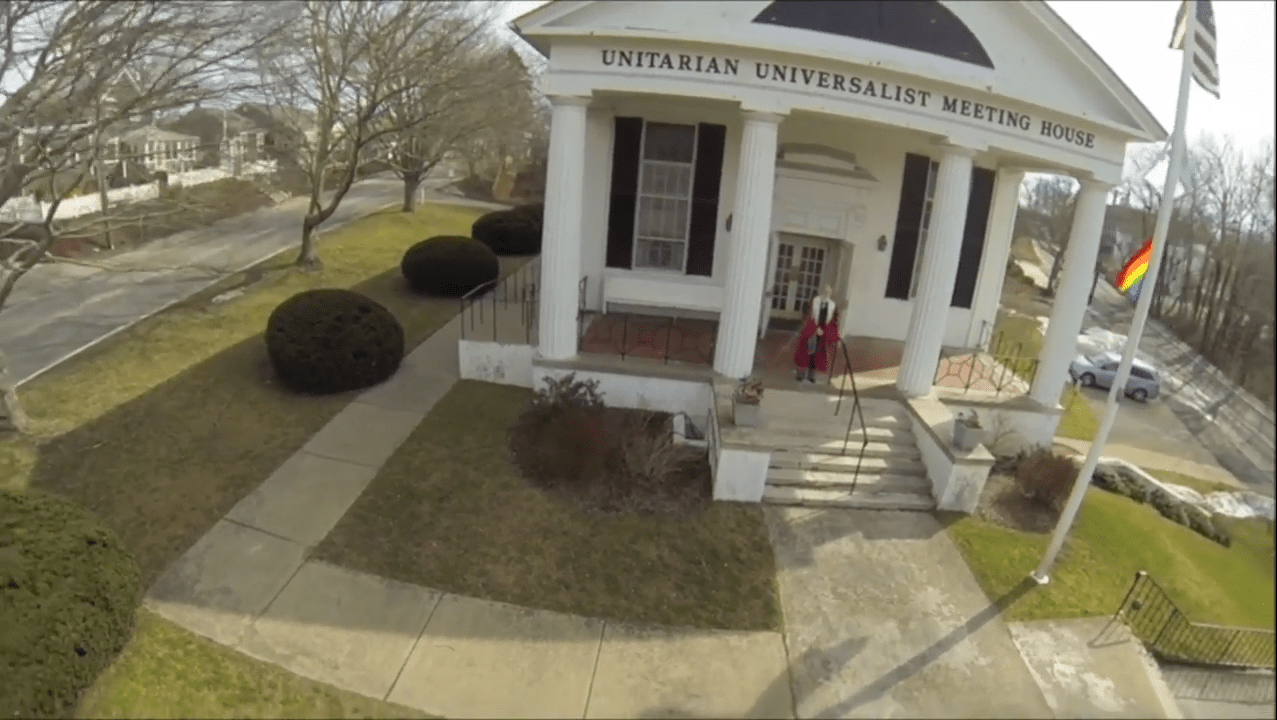
This video comes via the Rev. Edmond Robinson of the Unitarian Universalist Meeting House of Chatham, MA.  A light hearted outreach video featuring lyrics that nicely describes their congregation and Unitarian Universalism at large.

Official Video Description
A cute little song celebrating the UU Meeting House of Chatham, MA, at the “elbow” of Cape Cod, with performances by the Sunday School kids, the adults, the minister, members of the All Worn Out Jug Band, drone aerials of the building and scenes from vibrant church life.”

At the UU Meeting House
by Edmond Robinson

There’s little place in Chatham,
It’s where we like to meet
On a hill, by the village market on Main Street
We question all our answers, we cherish all our doubts
We look for good in everyone and try to work things out

Chorus
At the UU Meeting House (2x)
We welcome you, as we do your friends, your kids, your spouse
At the UU Meeting House (2x)
We share our hearts, our souls, our minds
At the UU Meeting House.

On old Cape Cod, some search for God while some are humanist
At the Meeting House, we all learn that we must coexist,
We tackle life’s big questions, what’s true and what is just
What we’d do to get out of this stew if it were up to us.Salvation’s not in heaven, or some far-distant place

But in the here and now we try to help the human race,
we’re all interconnected, soul answering to soul,
Loving the good things of this world, that’s just how we roll.